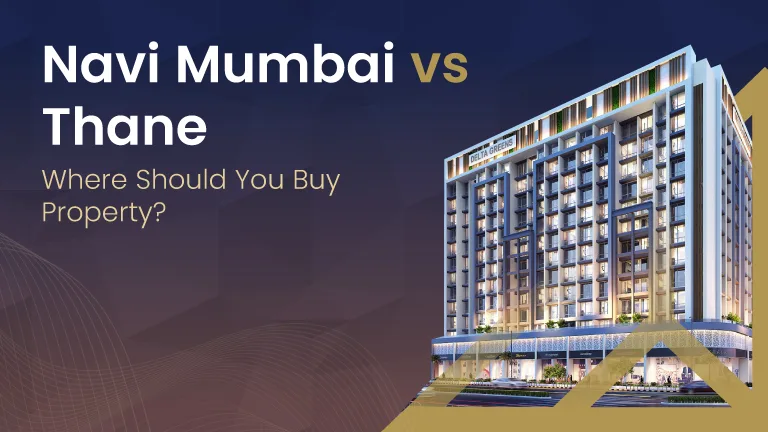
Navi Mumbai vs Thane: Where Should You Buy Property in 2026?
Navi Mumbai and Thane represent two significant and evolving urban centers in the Mumbai Metropolitan Region (MMR), each offering distinct advantages for property buyers. For those considering a property purchase, understanding the unique characteristics, growth trajectories, and lifestyle propositions of both regions is essential. This analysis aims to provide a comprehensive look at what Navi Mumbai and Thane offer, helping prospective homeowners make an informed decision when evaluating where to buy a flat near Mumbai. We will delve into aspects such as infrastructure, connectivity, social amenities, economic drivers, and future development prospects to illustrate the strengths of each location.
Understanding Navi Mumbai: A Planned Urban Oasis
Navi Mumbai was conceived in the 1970s as a futuristic, planned city designed to decongest Mumbai and facilitate organized growth. Developed primarily by CIDCO (City and Industrial Development Corporation), it stands out for its well-structured layout, wide roads, abundant green spaces, and meticulously planned sectors. This foundational planning has contributed to a quality of life that often draws comparisons with international urban standards.
Infrastructure and Connectivity in Navi Mumbai
The infrastructure in Navi Mumbai is a testament to its planned development. It boasts an expansive network of arterial roads, flyovers, and subways, facilitating smooth traffic flow. The Sion-Panvel Highway, Palm Beach Road, and Thane-Belapur Road are vital connectors, linking various nodes within Navi Mumbai and to other parts of MMR.
Public transportation is robust, with the Mumbai Suburban Railway’s Harbour Line forming its backbone, connecting residents to South Mumbai and Thane. The recently operationalized Navi Mumbai Metro, with its first phase connecting CIDCO’s Belapur to Pendhar, is progressively enhancing intra-city travel. Furthermore, the upcoming Navi Mumbai International Airport (NMIA) in Ulwe is poised to be a pivotal infrastructure project, significantly boosting connectivity and economic activity in the region. The proposed Mumbai Trans Harbour Sea Link (MTHL), connecting Sewri in Mumbai to Nhava Sheva in Navi Mumbai, promises to drastically reduce travel times to South Mumbai, further integrating Navi Mumbai into the broader economic landscape. For a detailed look at travel options, a Navi Mumbai vs Mumbai commute guide offers valuable insights.
Social and Civic Amenities in Navi Mumbai
Navi Mumbai excels in its provision of social infrastructure. It hosts a multitude of educational institutions, ranging from reputable schools affiliated with national and international boards to prominent colleges and universities offering diverse streams of study. Healthcare facilities are equally advanced, with numerous multi-specialty hospitals and clinics spread across the nodes, ensuring residents have access to quality medical care.
For recreation and leisure, Navi Mumbai offers an array of options. Large shopping malls, multiplexes, sports complexes, and sprawling parks are common. The planned nature of the city means ample open spaces and green zones, contributing to a healthier lifestyle. Major commercial hubs like Vashi, Belapur, and Nerul provide employment opportunities, making daily commutes shorter for many residents. Property options are diverse, including apartments, independent houses, and integrated townships. For those specifically looking for properties in Navi Mumbai, there are various options available across different budget segments.
Economic Landscape and Growth Drivers in Navi Mumbai
Navi Mumbai’s economy is highly diversified, driven by sectors such as IT and ITeS, logistics, manufacturing, and financial services. The MIDC industrial areas along the Thane-Belapur Road, coupled with various commercial business districts, provide a strong employment base. With the development of the NMIA and the JNPT port, Navi Mumbai is steadily evolving into a major logistics and trade hub. These developments are integral to the long-term market outlook for Navi Mumbai, suggesting sustained growth.
The planned development of specific nodes, such as Ulwe, has opened up new residential possibilities. Investment in flats in Ulwe is often seen as a forward-looking decision, anticipating the full realization of the airport and related infrastructure. Similarly, established areas like Airoli continue to attract professionals due to its robust connectivity and amenities, with numerous flats in Airoli catering to various preferences.
Delving into Thane: The City of Lakes
Thane, often referred to as the “City of Lakes,” holds a rich history and has undergone a remarkable transformation from a quiet suburban town to a bustling metropolitan center. Its strategic location, bridging Mumbai and other parts of MMR, has been a key factor in its growth. Thane’s development, unlike Navi Mumbai’s planned genesis, has been more organic, leading to a unique blend of old-world charm and modern conveniences.
Infrastructure and Connectivity in Thane
Thane’s connectivity is one of its primary strengths. It is a major railway junction on the Central Line of the Mumbai Suburban Railway, providing excellent access to South Mumbai, the eastern suburbs, and Kalyan-Dombivli. The Thane-Ghodbunder Road is a critical arterial road, connecting Thane to the Western Express Highway and facilitating access to the western suburbs of Mumbai. The Eastern Express Highway further links Thane to various parts of Mumbai.
Recent infrastructure boosts include the proposed Thane-Borivali tunnel, which aims to reduce travel time significantly between Thane and the western suburbs. The upcoming metro lines, particularly Metro Line 4 (Wadala-Ghatkopar-Thane-Kasarvadavali) and Metro Line 5 (Thane-Bhiwandi-Kalyan), are set to redefine public transport within Thane and its surrounding regions, making commutes more efficient and convenient. These projects highlight Thane’s commitment to improving urban mobility.
Social and Civic Amenities in Thane
Thane has a well-developed social infrastructure, catering to a diverse population. It boasts an array of educational institutions, including reputed schools and colleges, ensuring that residents have access to quality education within the city limits. The healthcare sector is robust, with several multi-specialty hospitals and clinics, providing comprehensive medical care services.
Shopping, dining, and entertainment options are plentiful in Thane. High-street retail, large shopping malls like Viviana Mall and Korum Mall, and numerous restaurants and cafes contribute to a vibrant lifestyle. The city’s numerous lakes, such as Upvan Lake and Masunda Lake, offer natural beauty and recreational spots, living up to its moniker. Thane’s cultural landscape is also vibrant, with various community events and festivals celebrated throughout the year.
Economic Landscape and Growth Drivers in Thane
Thane’s economy is diverse, with a strong presence of small and medium-sized enterprises, manufacturing units, and increasingly, IT and service sector companies. The city’s proximity to established industrial belts like Ghodbunder Road and the rapidly developing commercial areas along the Eastern Express Highway contribute significantly to employment generation. The commercial real estate market in Thane has seen substantial growth, with numerous office spaces and business parks attracting corporate entities.
The development along Ghodbunder Road has been particularly impactful, transforming it into a major residential and commercial corridor. This has led to a surge in new development projects, responding to the growing demand for housing and commercial spaces. The ongoing infrastructure projects and the expansion of the commercial sector are expected to further bolster Thane’s economic growth, making it an attractive destination for both businesses and residents.
Navi Mumbai vs Thane: A Comparative Analysis
When deciding between Navi Mumbai and Thane, it is beneficial to analyze them across several key parameters.
Planning and Urban Development
Navi Mumbai, by design, offers a more uniform and organized urban experience. Its wide roads, well-defined sectors, and extensive green cover are results of a master plan executed by CIDCO. This planned growth has led to efficient infrastructure and a high quality of life for many residents. For example, townships like Aveon City township exemplify this structured development, offering integrated living experiences. Even within established residential enclaves like Delta Palm Beach, Nerul, the benefits of thoughtful planning are evident.
Thane, in contrast, has grown more organically. While this has resulted in a charming blend of older neighborhoods and modern developments, it also means that some areas may experience challenges related to an older infrastructure or unplanned growth. However, this organic development has also fostered a strong sense of community and a richer historical context in some parts.
Connectivity and Commute
Both cities boast excellent connectivity, but their strengths lie in different directions. Navi Mumbai excels in its links to South Mumbai via the Harbour Line, and increasingly, to the rest of MMR with the upcoming MTHL and NMIA. Its internal road network is generally less congested.
Thane serves as a central hub, connecting to both Central and Western Railways, making it highly convenient for those commuting to various parts of Mumbai. The upcoming metro lines are set to significantly enhance intra-Thane and regional connectivity. However, certain key roads in Thane can experience high traffic volumes during peak hours.
Affordability and Property Values
Property values in both Navi Mumbai and Thane have seen consistent appreciation over the past decade, driven by infrastructure development, economic growth, and increasing demand. Generally, property in Navi Mumbai, particularly in established nodes like Vashi, Nerul, and Belapur, can be at a premium due to its planned infrastructure and sustained demand. However, newer nodes like Ulwe offer more competitive entry points with significant appreciation potential.
Thane also presents a diverse range of property prices. Areas along Ghodbunder Road and in close proximity to the railway station tend to be more sought-after. The growth in Thane has led to a significant increase in the property inventory for both residential and commercial spaces. Both regions offer numerous new projects in Navi Mumbai and Thane, catering to various budgets and preferences.
Lifestyle and Environment
Navi Mumbai is often praised for its green spaces, clean environment, and serene atmosphere, particularly in residential areas. The emphasis on planned green zones and recreational facilities contributes to a relaxed lifestyle. Its modern infrastructure supports a comfortable and convenient living environment.
Thane, with its lakes and historical sites, offers a blend of natural beauty and urban buzz. It presents a more traditional city feel combined with rapidly modernizing amenities. The social fabric often feels more established due to its longer history as a significant urban center.
Future Growth Prospects
Both Navi Mumbai and Thane are primed for continued growth. In Navi Mumbai, the completion of the Navi Mumbai International Airport, the MTHL, and the expansion of the metro network are expected to act as major catalysts for economic and real estate growth. The development of NAINA (Navi Mumbai International Airport Influence Notified Area) is also significant, drawing in further investment and residents.
Thane’s growth trajectory is strongly supported by its evolving metro network, the proposed Thane-Borivali tunnel, and ongoing commercial developments. Its strategic position within the MMR ensures that it will remain a crucial hub for commerce and residential living. The development of various smart city initiatives in Thane also points towards a future of sustained progress.
Making Your Decision
The choice between Navi Mumbai and Thane ultimately depends on individual preferences, lifestyle requirements, and investment goals.
- For those who prioritize planned development, modern infrastructure, and a relatively less congested environment, Navi Mumbai might be the preferred choice. Its emphasis on green spaces, wide roads, and newer facilities appeals to those seeking a well-organized urban experience.
- For individuals who value strong connectivity to various parts of Mumbai, a vibrant established community, and a blend of traditional charm with modern amenities, Thane could be more appealing. Its extensive commercial activity and robust public transport network are significant draws.
Consider factors such as your workplace location, the commute you are comfortable with, the types of social amenities you prioritize, and your long-term investment horizon. Visiting both locations, exploring various neighborhoods, and speaking with residents can provide invaluable insights to help you make an informed decision.
Key Takeaways
- Navi Mumbai is a planned city known for its organized infrastructure, wide roads, green spaces, and modern amenities.
- Thane offers strong connectivity across MMR, a blend of historical charm with modern developments, and diverse social infrastructure.
- Navi Mumbai’s growth is driven by projects like the Navi Mumbai International Airport and MTHL, while Thane benefits from its expanding metro network and proposed infrastructure.
- Property values in both regions have seen appreciation, with options available for various budget segments.
- The choice between Navi Mumbai and Thane depends on individual priorities regarding lifestyle, commute, and preferred urban environment.
- Both cities offer robust investment potential due to ongoing and planned infrastructure development.
Frequently Asked Questions
Quick answers to common questions on this topic.
Navi Mumbai typically offers a more suburban, planned lifestyle with ample green spaces, wider roads, and a focus on modern amenities. Thane, being an older city, presents a more urban, bustling environment with a blend of historical areas and newer developments, offering a vibrant community life.
Both cities offer good connectivity, but through different routes. Navi Mumbai connects efficiently via the Harbour Line and will benefit significantly from the Mumbai Trans Harbour Sea Link. Thane connects via the Central Line and Eastern Express Highway, acting as a central hub to various parts of Mumbai.
Property prices fluctuate based on specific neighborhoods, project types, and amenities. Generally, established nodes in Navi Mumbai (like Vashi or Nerul) can be premium, while newer nodes might offer more competitive entry points. Thane also has a range of prices, with areas closer to the railway station and along Ghodbunder Road often commanding higher values. Both regions are considered investment-worthy.
Both cities are excellent choices for families. Navi Mumbai is praised for its planned green spaces, numerous parks, and well-regarded educational institutions. Thane also boasts a wealth of schools, colleges, and recreational facilities, alongside a strong community feel. The choice often comes down to personal preferences regarding the urban environment.
Navi Mumbai’s real estate market is significantly driven by major infrastructure projects such as the Navi Mumbai International Airport, the Mumbai Trans Harbour Sea Link, and the ongoing Metro expansion. Thane’s growth is propelled by its expanding metro network, proposed infrastructure projects like the Thane-Borivali tunnel, and its strategic position as a commercial and residential hub in the MMR.